 oks-ui
Omkar Sahu · 5 min read
I built six templates only with oks-ui, as real applications and not as demos, and I kept every commit. This post reads that history to answer one question: where did the effort actually go? Along the way the templates also found bugs in the library, and I list those too.
What was built
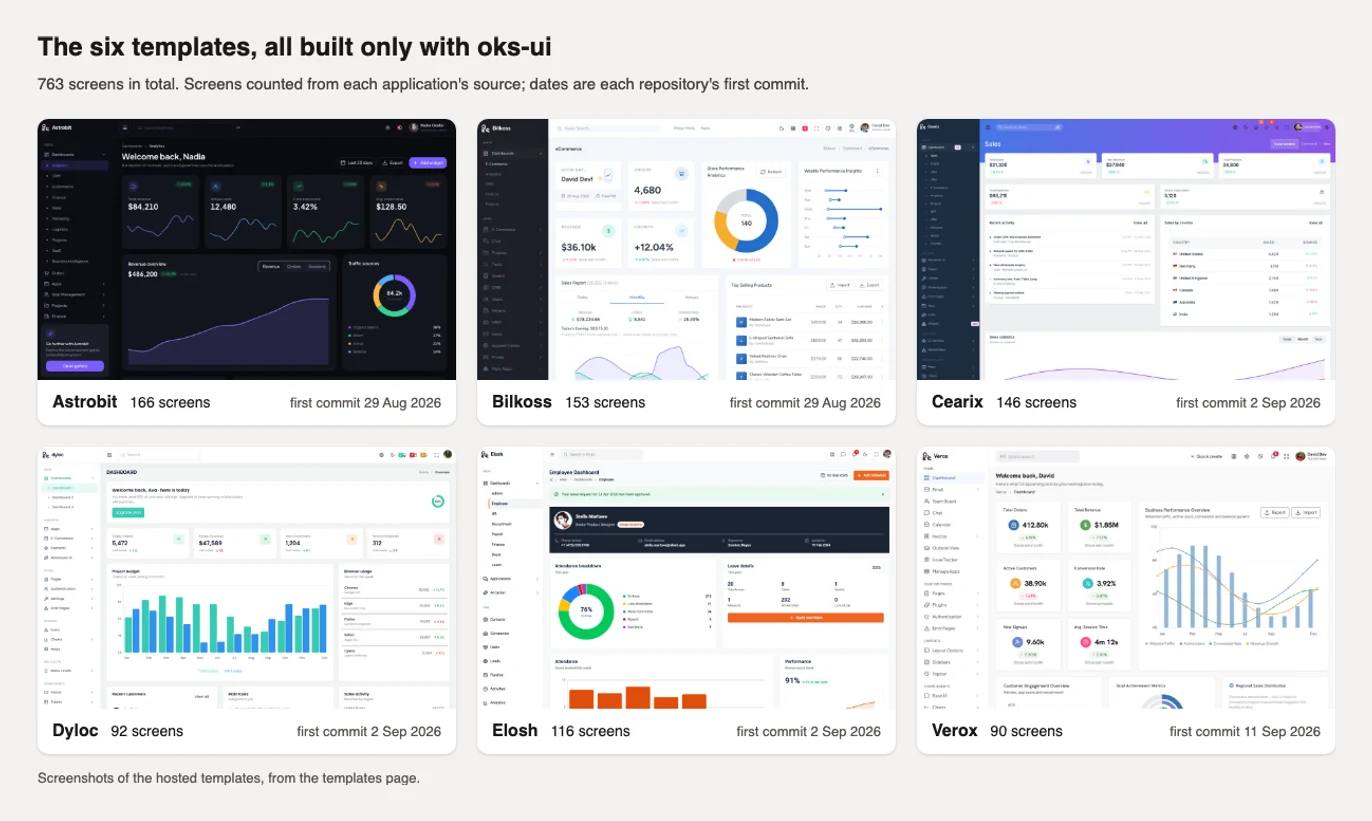
Six templates are live on the templates page, each a React single-page application that runs in the browser and, for most, publishes its source. They are Astrobit, Bilkoss, Cearix, Dyloc, Elosh and Verox. The screen counts are taken from each application's source, not estimated:
- Astrobit: 166 screens, 33 oks-ui components
- Bilkoss: 153 screens, 35 components
- Cearix: 146 screens, 36 components
- Dyloc: 92 screens, 34 components
- Elosh: 116 screens, 32 components
- Verox: 90 screens, 37 components
Together that is 763 screens. The largest, Verox, uses 37 different oks-ui components. None of them adds a second component, form or charting library: the interface is oks-ui, the routes are React Router, and most use Lucide for icons. Verox also uses Tailwind CSS and Dyloc uses Framer Motion, and that is the extent of it.
This post asks one question: what took the longest? Hours were not tracked, so the answer comes from the only record there is, the git history of each repository. Commit counts are a rough measure of effort, not a precise one, and they are used that way here.
The first screens came fast
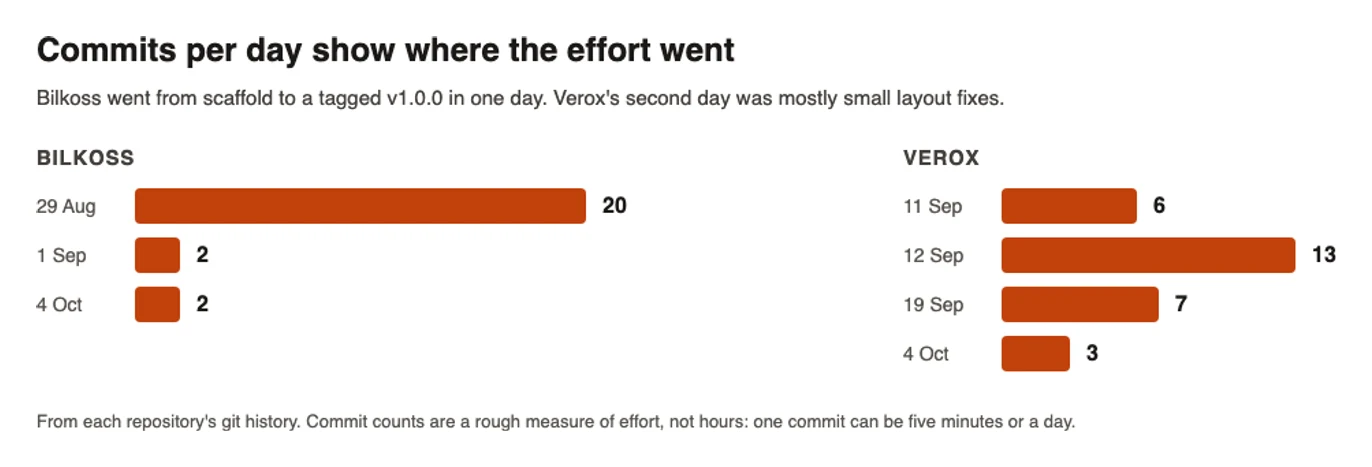
The earliest commits are dated 29 August 2026 for Astrobit and Bilkoss, 2 September for Cearix, Dyloc and Elosh, and 11 September for Verox. Bilkoss is the clearest case: 20 of its 24 commits are dated 29 August, from the first scaffold to a tagged v1.0.0 with a GitHub Pages workflow. By the end of that one day it had five dashboards, 24 list routes and a component gallery.
That speed has a cause, and it is worth copying. The screens are not written one by one. A list, a form, a settings page, a detail page or a report is described by a configuration object and drawn by one shared layout, which the project calls an archetype. Dyloc and Elosh both say so in their descriptions: list, form, settings and detail screens are config, not separate components. A new CRUD screen is a few lines of data. Bilkoss wired 24 list routes in a single commit for that reason.
Advertisement
What took the longest: the last 10 percent of a layout
The longest stretches in the histories are all the same activity: nudging a finished screen until it looks the way it should.
Verox is the example. It had a working shell, routing, a dashboard, its authentication pages and a first set of gallery pages in six commits on 11 September. On 12 September it has 13 commits, and the subjects read like a checklist of small things: card title weight and colour, column ratios, card shadow and radius, the active item in the sidebar, the border on the header, a Quick create button whose icon and text stacked instead of sitting inline, a horizontal scrollbar in the sidebar, a rebuilt KPI card, an empty gap in a row of charts, and the strokes of a ring gauge. Nothing on that list is a feature. Each one is a difference of a few pixels or a few shades.
Bilkoss shows the same shape. After the first day of building, two later commits are rounds of "fidelity" work on the dashboards, adjusting proportions, tab styling and chart details. Seven of its commit subjects mention layout, spacing or matching a target. The lesson is not that the library was slow. It is that a screen can be complete in an hour and finished in a week, and the second part is the cost to plan for.
Dark mode and accessibility came last, and cost the same everywhere
Dark mode needed its own fixes in four of the six. Astrobit's follow-up on 1 September mentions dark ramps and gauge charts, and Dyloc and Elosh both have "dark-mode ramps" in their final accessibility commit. Verox needed a dark-mode fix on 19 September, because its own colour variables collided with names that oks-ui already defines.
Then on 4 October the same commit went into all six repositories: text contrast, landmarks and heading order. Bilkoss's version adds field labels. They were the same three classes of defect in every template:
- Contrast. Muted text that was just under 4.5:1 on a tinted surface, and labels that went black on a dark fill after the library's colour ramps became theme-aware in 1.2.0.
- Landmarks. Pages without a
mainelement. - Heading order. A card title that jumped a level, or a page with no single
h1.
After the fixes each template had zero contrast violations from axe-core in the light and the dark theme, and a check at 390 and 768 pixels wide found no horizontal overflow, after one fix: the header of Verox, where an icon-only Quick create button was needed below the small breakpoint. If you are building an application of your own, run those two checks on the first day. They are cheap then and they are a whole round of commits at the end.
The templates found bugs in the library
Building real screens is the best test the library has had. Several fixes in the oks-ui changelog name the templates that exposed them:
- Donut and pie charts rendered as a tiny blob when the browser did not deliver a resize notification (a hidden document, or React 19 with StrictMode running an effect twice). Bilkoss worked around it by composing its own SVG ring. The chart's width is now read at mount in 1.1.0, and on 1 September Bilkoss moved to the 1.1 components and retired its composed workarounds.
- A switch field warned about being controlled and uncontrolled at once. It passed both
checkedanddefaultCheckedto the input on every render. Fixed in 1.1.2, noted against Bilkoss. - A brand colour set on a bare `:root` vanished in dark mode. The dark tokens outranked it. Fixed in 1.1.2 by giving both sets of tokens zero specificity.
- Clicking a sortable column header scrolled a wide table sideways, hiding the first columns. Also in 1.1.2.
These are the bugs a unit test does not find, because they need a whole page with real content, a real theme and a real browser.
What to take from it
- Describe screens as data. It is why six applications and 763 screens were possible, and it keeps the screens consistent.
- Budget for the last 10 percent, and for a polish pass on spacing, weights and borders.
- Do dark mode and the accessibility pass first, or at least early. They found the same defects in all six.
- Name your own variables so they cannot collide with the library's.
- Build something real on the library you publish. It finds things nothing else does.
Where to see them
All six run live from the templates page, and the screen and component counts above are on each template's own page. The accessibility results are written up in the accessibility audit, and the contrast changes in the post on theming.
Limits
Commit counts are not hours. A single commit can be five minutes or a day, and some work (design decisions, reading, testing in the browser) leaves no commit at all. The dates are the first and last commits of each repository, as of 9 November 2026, and the templates keep being updated. The bug list is the part the changelog connects to a template by name, so it is not every bug they found.
If you build on one of these templates and hit something the histories do not explain, tell me through the contact page and I will add it here.